
.svg)


.webp)
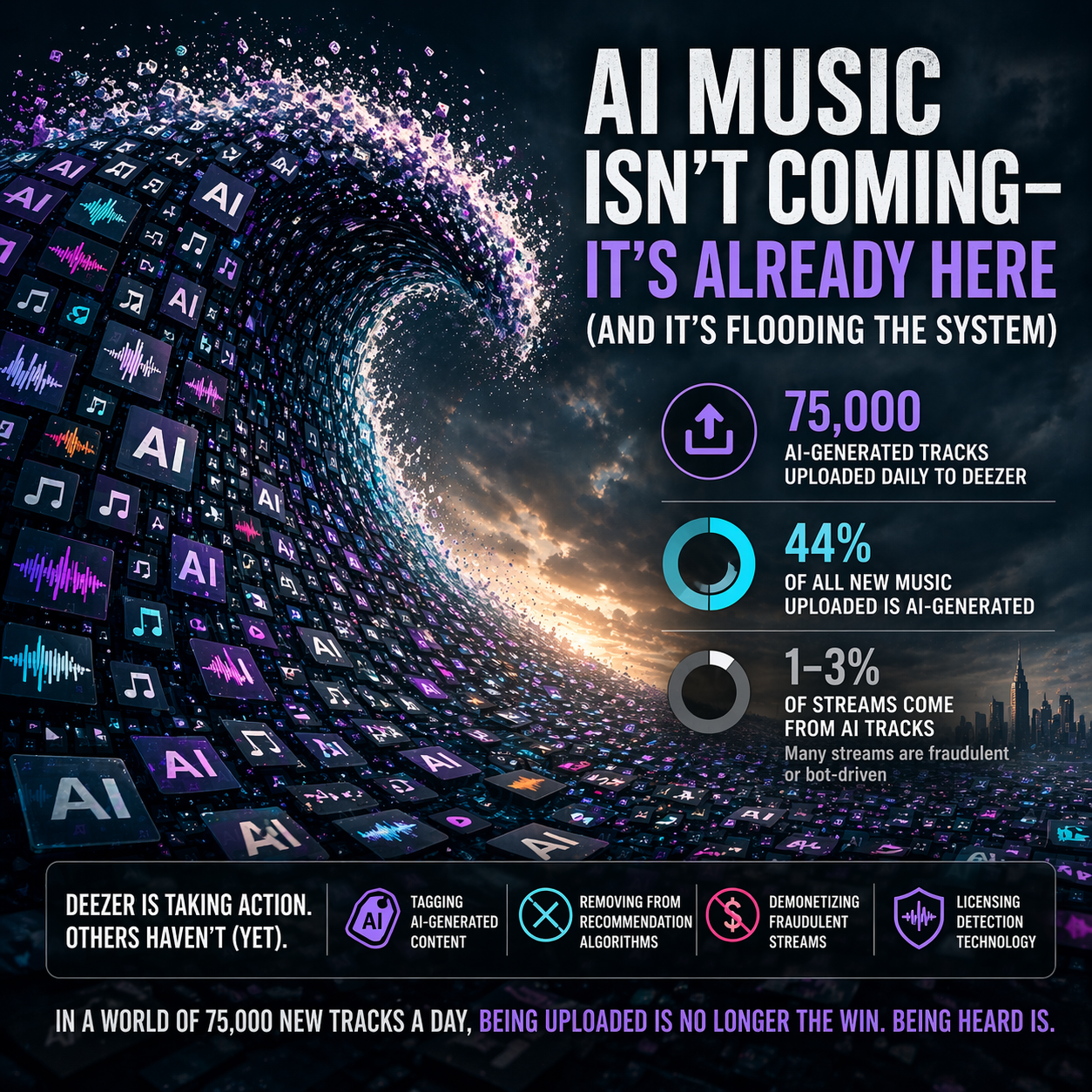
There’s a stat that should make everyone in the music industry pause. Nearly half of all new music being uploaded to Deezer is now AI-generated. Not 5%, not 10%, but 44% - roughly 75,000 tracks per day. Let that sink in for a second. This isn’t a future problem we can debate or prepare for. It’s already happening, and it’s happening at scale.
The real issue here isn’t AI itself - it’s volume. Artists using AI as a tool is not inherently a problem, and neither is producers experimenting with new workflows. That kind of innovation has always been part of music. What’s different now is the rise of industrial-scale content generation. When tens of thousands of tracks can be created and uploaded daily, the bottleneck shifts away from creation and moves directly into distribution and discovery. And that’s where things begin to break, because platforms were never designed to handle this level of supply.
What makes this even more complex is that most of this content isn’t driven by real demand. Despite the massive volume of AI-generated uploads, only around 1–3% of total streams actually come from these tracks. And even within that small percentage, a significant share appears to be fraudulent or bot-driven, created not to reach listeners but to exploit royalty systems. What we’re really looking at is a combination of massive supply, minimal genuine consumption, and increasing manipulation. That’s not a creative revolution - it’s a system under pressure.
At its core, this is less a technology problem and more a distribution problem. One uncomfortable truth is that this flood of content doesn’t happen without distribution infrastructure enabling it. Every one of those 75,000 tracks per day is being delivered through the same pipelines used by legitimate artists. That means the real pressure point is no longer just about who can create music, but about who gets access, how content is filtered, and how value is ultimately assigned. Distribution is no longer just about access - it’s becoming curation at scale.
To their credit, Deezer is one of the few platforms actively addressing this shift. They’ve started tagging AI-generated content, removing it from recommendation algorithms, demonetizing fraudulent streams, and even exploring licensing their detection technology. It’s a strong and necessary stance, but it also highlights how fragmented the broader industry response still is. Some platforms are experimenting with transparency, while others remain largely silent. That inconsistency is going to become a real issue as the volume continues to grow.
For artists, this isn’t an abstract discussion. The impact is immediate. More supply means more competition for attention, more noise within algorithms, and more pressure on already strained discovery systems. On top of that, if fraud isn’t properly controlled, there’s a real risk of further dilution in revenue pools. The bar is no longer just about making good music. It’s about finding a way to stand out in an environment where content is effectively infinite.
And this trend isn’t going to reverse. AI tools will continue to improve, become faster, and get cheaper. Upload volumes will keep rising, platforms will be forced to react, and distribution will inevitably become more selective. Interestingly, as automation increases, the value of human input - taste, strategy, and genuine curation - becomes more important, not less.
Over the past decade, the industry has focused on democratizing access to distribution, and that shift was necessary. But we’re now entering a new phase where access alone is no longer the differentiator. What matters is who is actually being worked, who is being positioned effectively, and ultimately, who is able to cut through the noise. Because in a world where 75,000 new tracks are uploaded every day, being uploaded is no longer the win - being heard is.
.webp)
.webp)

