
.svg)
.png)


.webp)
Latin music isn’t just growing — it’s redefining the global music industry.
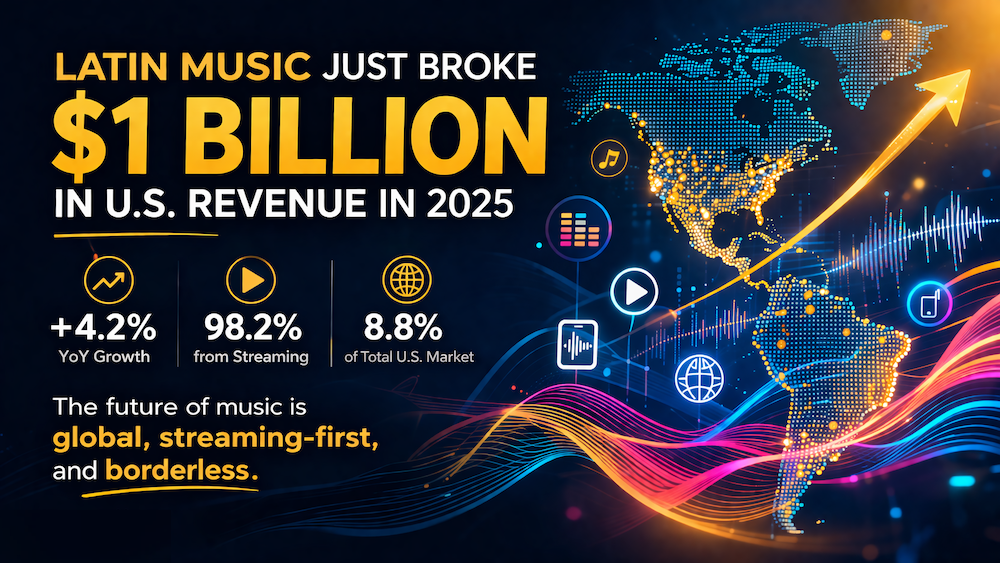
According to the latest RIAA data, Latin music generated over $1 billion in U.S. recorded music revenue in 2025, marking a historic milestone and reinforcing its position as one of the fastest-growing segments in the business.
But beyond the headline number, the deeper story reveals something even more important for independent artists and labels.
This isn’t a one-year spike.
Latin music has now delivered 10 consecutive years of growth in the U.S., consistently outperforming the overall market.
In 2025 alone:
To put that in perspective: Latin music has grown from just $140 million in 2015 to over $1 billion today — a massive cultural and commercial shift in just a decade.
If there’s one takeaway, it’s this: Latin music is a streaming-first ecosystem.
That’s significantly higher than the overall U.S. market, where streaming accounts for about 82% of revenue.
What does this mean?
Latin music is not just participating in the streaming era — it’s leading it.
One of the biggest drivers behind this growth is simple: language is no longer a barrier.
Artists like Bad Bunny, Karol G, Anuel AA, and Peso Pluma have helped push Latin music into mainstream global culture - not by adapting to markets, but by bringing their sound worldwide.
Streaming platforms, social media, and global playlists have turned regional genres into international movements.
This shift isn’t just benefiting major labels — it’s opening doors for independent artists globally.
Here’s why:
Your audience is no longer limited by geography. Latin music proves that audiences are willing to discover and embrace music across languages and cultures.
With nearly all revenue coming from streaming, success is driven by:
What used to be considered “regional” can now become global — faster than ever.
Latin music’s rise reflects a broader transformation in the music industry:
And perhaps most importantly:
Independent artists now have the same global infrastructure as major labels — if they use it right.
Crossing the $1 billion mark isn’t just a milestone - it’s a signal.
Latin music is no longer a “genre to watch.”
It’s a blueprint for how music grows in the modern era.
For artists, labels, and distributors, the takeaway is clear:
The future of music is global, streaming-first, and culturally diverse.
.webp)
.webp)

