
.svg)


.webp)
Spotify has quietly rolled out one of its most interesting features in years - and if you’re an artist, producer, or rights holder, it’s worth paying attention.
It’s called SongDNA, and on the surface, it looks like just another discovery tool. But when you dig a little deeper, it’s actually a shift in how music is understood, credited, and ultimately discovered.
For years, streaming platforms have centered discovery around the artist and the track. But anyone in the industry knows that’s only part of the story.
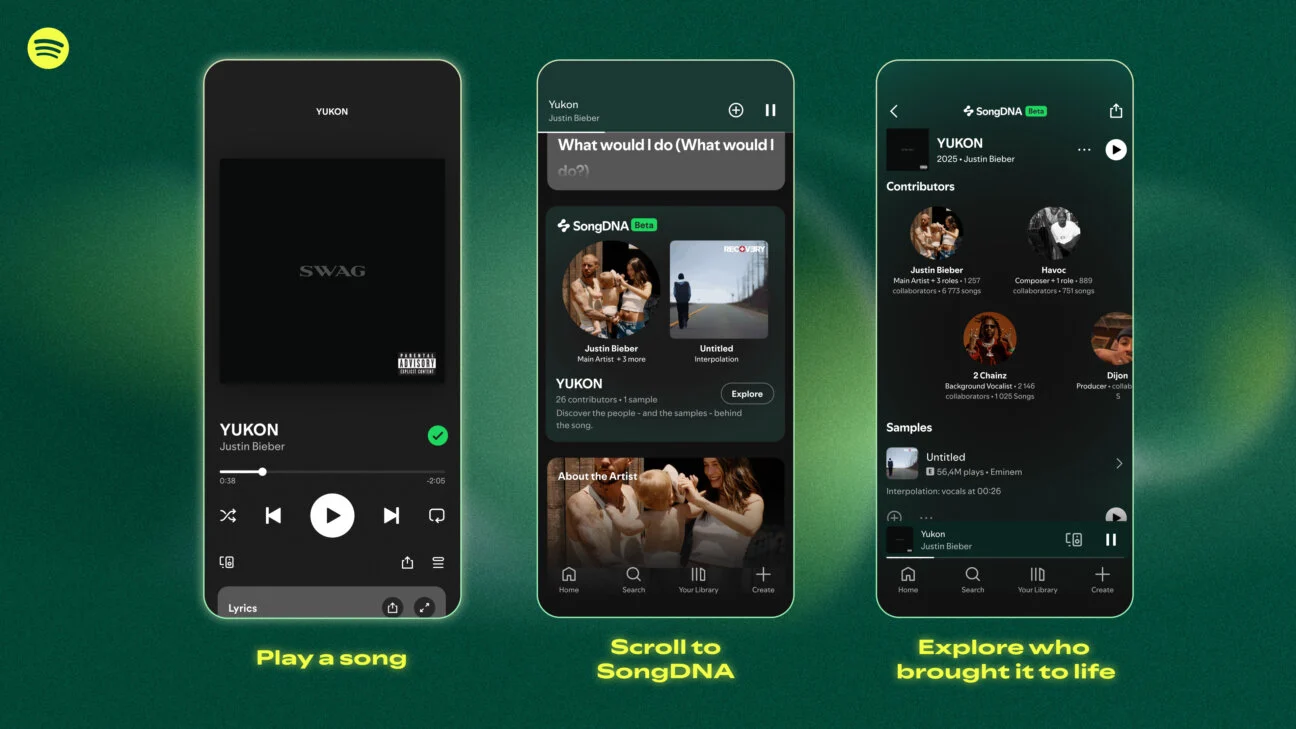
SongDNA flips that: Instead of stopping at the headline artist, it opens up the full creative network behind a song - producers, writers, engineers, collaborators - and connects them across other works.
In practical terms, this means fans can now explore music through the people who actually make it, not just the names on the cover.
What makes SongDNA particularly interesting is how it visualizes relationships.
The feature maps out:
All of this creates what is essentially a “music graph” - a living web of connections between songs, genres, and eras.
For listeners, it’s a rabbit hole. For the industry, it’s something bigger: a new discovery layer that isn’t driven purely by algorithms, but by creative relationships.
This is where things get real.
SongDNA isn’t just about curiosity - it’s about visibility.
Historically, many contributors behind a track haven’t been discoverable in meaningful ways. Even when credits exist, they’re rarely part of the discovery journey.
SongDNA changes that by:
That means producers, writers, and collaborators now have a clearer path to recognition — and potentially new opportunities.
A big part of this rollout is powered by Spotify’s acquisition of WhoSampled, which brings deep data around samples, covers, and musical lineage into the platform.
Combined with artist-supplied metadata, this creates a much richer and more accurate picture of how songs are connected.
And importantly, artists and rights holders will be able to manage how their information appears through Spotify for Artists - which puts more control back into the hands of creators.
Zooming out, SongDNA is part of a broader trend: transparency in music creation.
We’re seeing a move away from black-box discovery toward:
And that matters - not just culturally, but commercially.
Because when fans understand the story behind a song, they engage with it differently.
For distributors and labels, this is a signal.
Metadata is no longer just administrative - it’s discoverable, clickable, and increasingly tied to fan experience.
If your credits aren’t complete or accurate, you’re not just missing data - you’re missing exposure.
And as platforms continue to build around connections rather than just content, the value of clean, detailed metadata will only increase.
SongDNA might look like a feature, but it’s really a direction.
A move toward a more connected, transparent, and credit-driven music ecosystem - where every contributor has a chance to be discovered, not just the headline artist.
For anyone putting music into the world, that’s a shift worth watching closely.
Source: Music Business Worldwide
.webp)
.webp)

