
.svg)


.webp)
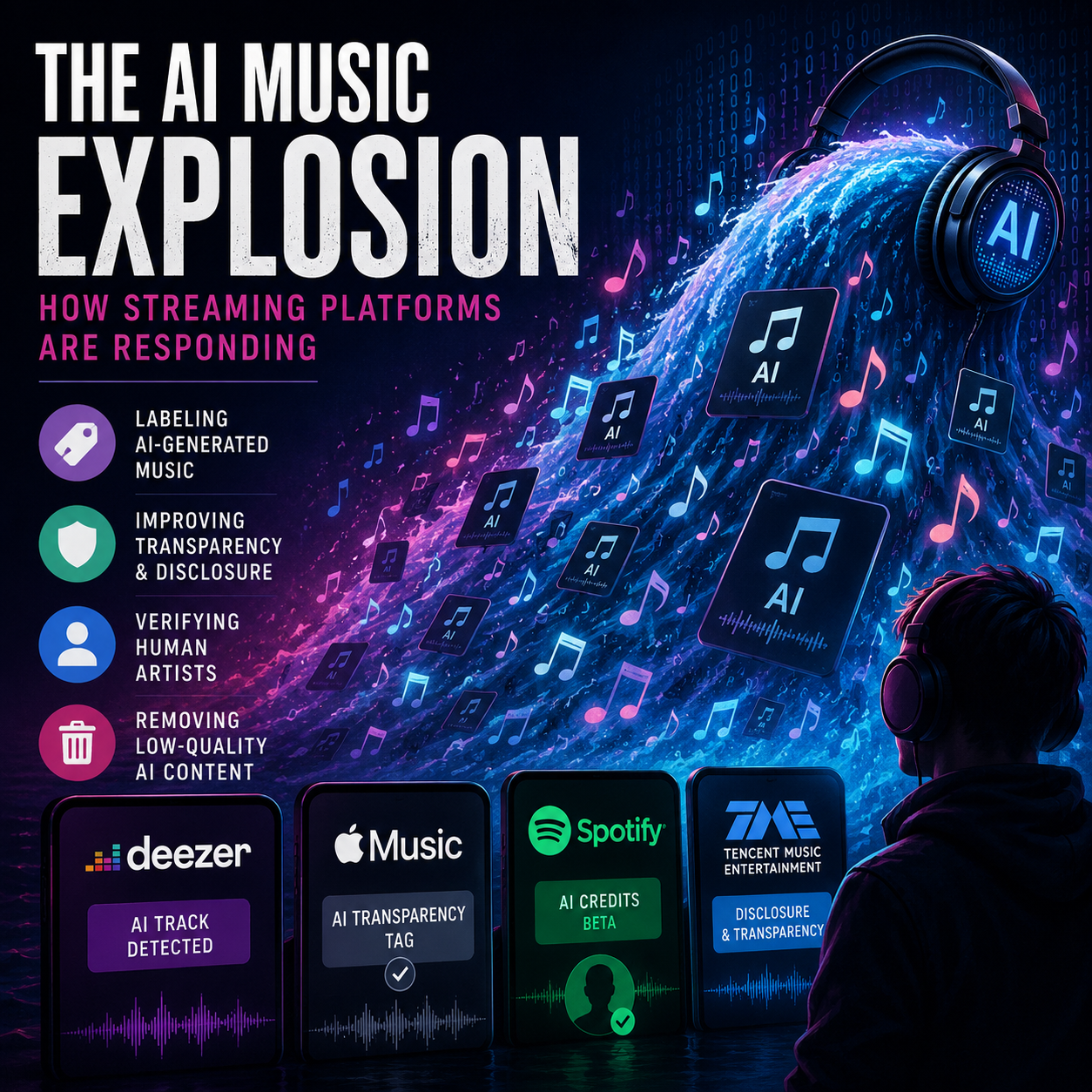
As AI-generated music floods digital platforms at an unprecedented pace, streaming services are racing to adapt - and Tencent Music Entertainment (TME) is the latest major player to confront the challenge head-on.
The company’s recent disclosure highlights a growing industry-wide reality: AI music is no longer a niche experiment. It’s becoming a significant portion of the content uploaded to streaming platforms every day, forcing companies to rethink transparency, moderation, and artist verification.
Deezer has emerged as one of the most aggressive platforms in this space. After rolling out what it described as the industry’s first dedicated AI music detection and labeling system in June 2025, the company revealed in April 2026 that it was now receiving close to 75,000 fully AI-generated tracks every single day. According to Deezer, those uploads now represent approximately 44% of all new music added to the platform daily. Over the course of 2025 alone, the company says it identified and tagged more than 13.4 million AI-created tracks.
Other streaming giants are taking different approaches.
Apple Music entered the conversation in March 2026 with the launch of its AI Transparency Tags - a metadata framework designed to identify AI involvement in music creation. Labels and distributors can already begin applying the tags voluntarily, although Apple plans to make the disclosures mandatory for future releases. Critics, however, point out that the system currently depends largely on self-reporting from rights holders.
Spotify has also stepped deeper into AI disclosure efforts. In April 2026, the platform introduced an “AI Credits” beta feature built around the DDEX metadata standard, enabling creators to specify where AI tools were used during the creative process - whether for vocals, instrumentation, mastering, or post-production work.
At the same time, Spotify has been aggressively cleaning up its catalog. The company says it has removed more than 75 million tracks it categorized as low-quality or “spammy” content, much of it linked to mass-produced AI uploads. Toward the end of April, Spotify also launched a “Verified by Spotify” badge intended to help listeners distinguish authentic human artists from entirely AI-generated personas.
Taken together, these developments signal a major turning point for the music industry. As generative AI tools become more accessible, streaming services are no longer debating whether AI music belongs on their platforms — they’re now focused on how to manage, label, and regulate it responsibly.
.webp)
.webp)

