
.svg)


.webp)
The debate around AI-generated deepfakes is no longer just a technology story. It's quickly becoming a music industry story, a creator rights story, and increasingly, a legal one.
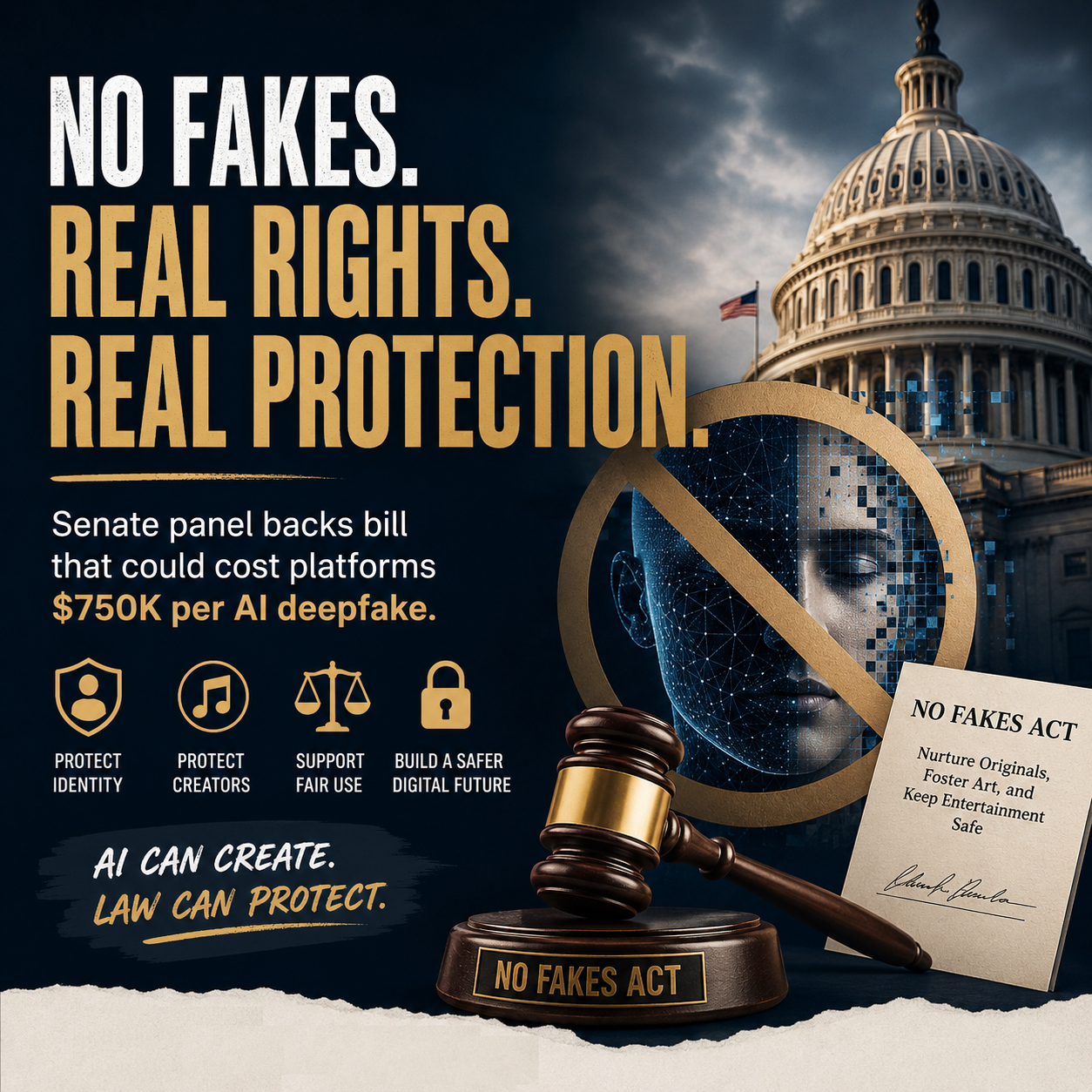
According to reporting by Music Business Worldwide, the U.S. Senate Judiciary Committee has advanced the NO FAKES Act, a bipartisan bill aimed at protecting people from unauthorized AI-generated replicas of their voice and likeness. The legislation could impose penalties of up to $750,000 per unauthorized work on platforms that knowingly host or distribute unlawful AI-generated replicas.
For anyone following the rapid growth of generative AI, this feels like a significant moment.
The NO FAKES Act (short for "Nurture Originals, Foster Art, and Keep Entertainment Safe") would establish a federal right allowing individuals to control how their voice and likeness are used in AI-generated content. In practical terms, that means artists, creators, public figures, and even everyday individuals could have stronger legal protections against unauthorized digital clones.
What's particularly notable is the coalition supporting the bill. The legislation has attracted backing from major music companies, industry organizations, and increasingly, technology companies. Supporters include music giants such as Universal Music Group, Sony Music, and Warner Music Group, alongside organizations like the RIAA and Recording Academy. Tech companies including Google, YouTube, OpenAI, and Spotify have also expressed support for versions of the legislation.
The reason this matters is simple: AI-generated impersonations are getting better, faster, and more accessible.
Whether it's fake songs mimicking an artist's voice, unauthorized endorsements, scams, or manipulated media, the line between real and synthetic content continues to blur. The music industry has been particularly vocal about the risks, arguing that artists should retain control over their identity in the same way they control their intellectual property.
At the same time, the conversation isn't about stopping AI altogether. Many of the organizations backing the bill are also actively investing in AI technologies. The focus appears to be on creating guardrails that allow innovation while protecting individuals from misuse.
There's still a legislative process ahead before the bill becomes law, but the committee's approval represents meaningful momentum. After several previous attempts that stalled before reaching the finish line, supporters are hoping this version has a stronger chance of moving through Congress.
As AI continues reshaping creative industries, one question is becoming increasingly important: who owns your voice, your face, and your digital identity? The NO FAKES Act is one of the clearest attempts yet to answer that question.
Source: This article is based on reporting by Music Business Worldwide's coverage of the NO FAKES Act and related developments in U.S. AI regulation. Original reporting can be found at Music Business Worldwide.
.webp)
.webp)

