



Some news landed this week that matters more to independent artists than it might seem at first. Billboard has changed how it weighs ad-supported streams against paid subscription streams on its US charts. In response, YouTube is bringing its data back to the charts after almost a year away.
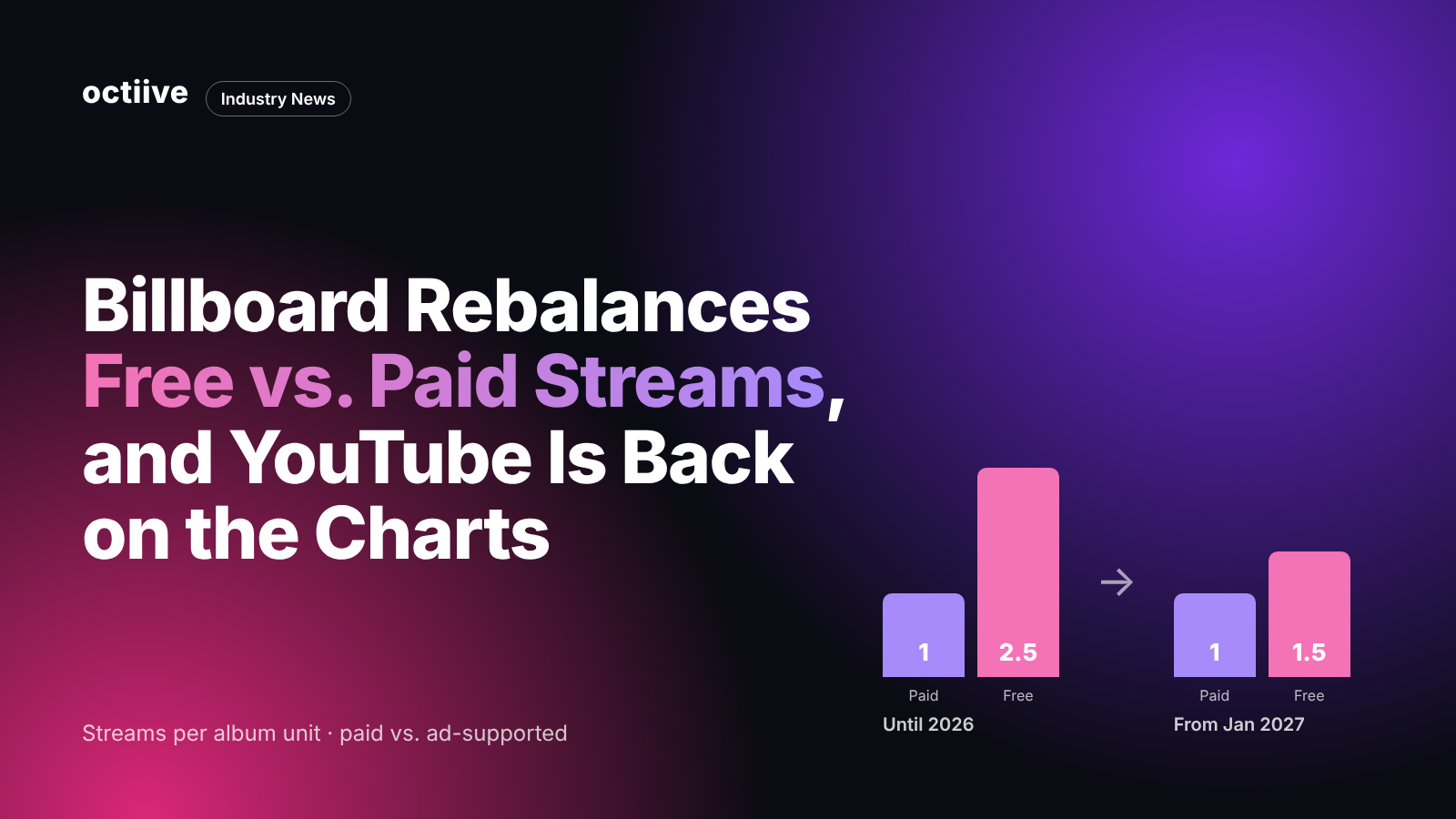
Until now, a paid subscription stream counted 2.5 times as much as a free, ad-supported stream on the Billboard 200. Billboard is narrowing that gap to 1:1.5:
The new ratio first applies to the Billboard 200 and its genre album charts dated January 16, 2027, which cover streams from January 1–7. Billboard says the change came out of its annual revenue review with Luminate. The goal is to keep the charts in line with what each type of stream actually earns.
In December 2025, Billboard moved the ratio from 1:3 to 1:2.5. YouTube said that wasn't enough. Lyor Cohen, YouTube's Global Head of Music, called the formula outdated because it ignores the huge number of fans who listen without a subscription. YouTube stopped sending its data, and it has been missing from the charts since late January 2026.
Now Cohen has confirmed: "We are returning to the Billboard charts starting in 2027."
I've worked in this industry for more than 25 years, and I've watched the line between "free" and "paid" listening keep moving. This change is a clear signal. Ad-supported listening is being treated as real fan engagement, and that's what it is.
For independent artists, a lot of discovery happens on free tiers: YouTube, Spotify Free, and short-form video that sends people to full tracks. A new fan rarely starts with a paid subscription. They start by watching a video or catching a song in a playlist. With YouTube's numbers counting again and ad-supported streams weighted more fairly, that
early momentum shows up in the charts more accurately.
Some practical takeaways:
YouTube says it paid the music industry more than $8 billion in the year to June 2025, and YouTube Music and Premium recently passed 150 million subscribers including trials. Both engines are running, and the charts are finally starting to reflect that.
At Octiive, we'll keep making sure your releases reach every platform where fans listen, whether they pay or not.
Source: Music Business Worldwide, "Billboard changes 'free' vs. paid streaming formula on charts – and YouTube is bringing its data back," November 9, 2026 (musicbusinessworldwide.com). See also Billboard's announcement (billboard.com).

Ressourcen
Musik veröffentlichenMusik online verkaufenMusik-TantiemenFür LabelsOctiive PathwayDistroKid-AlternativenVertrieb wechseln

